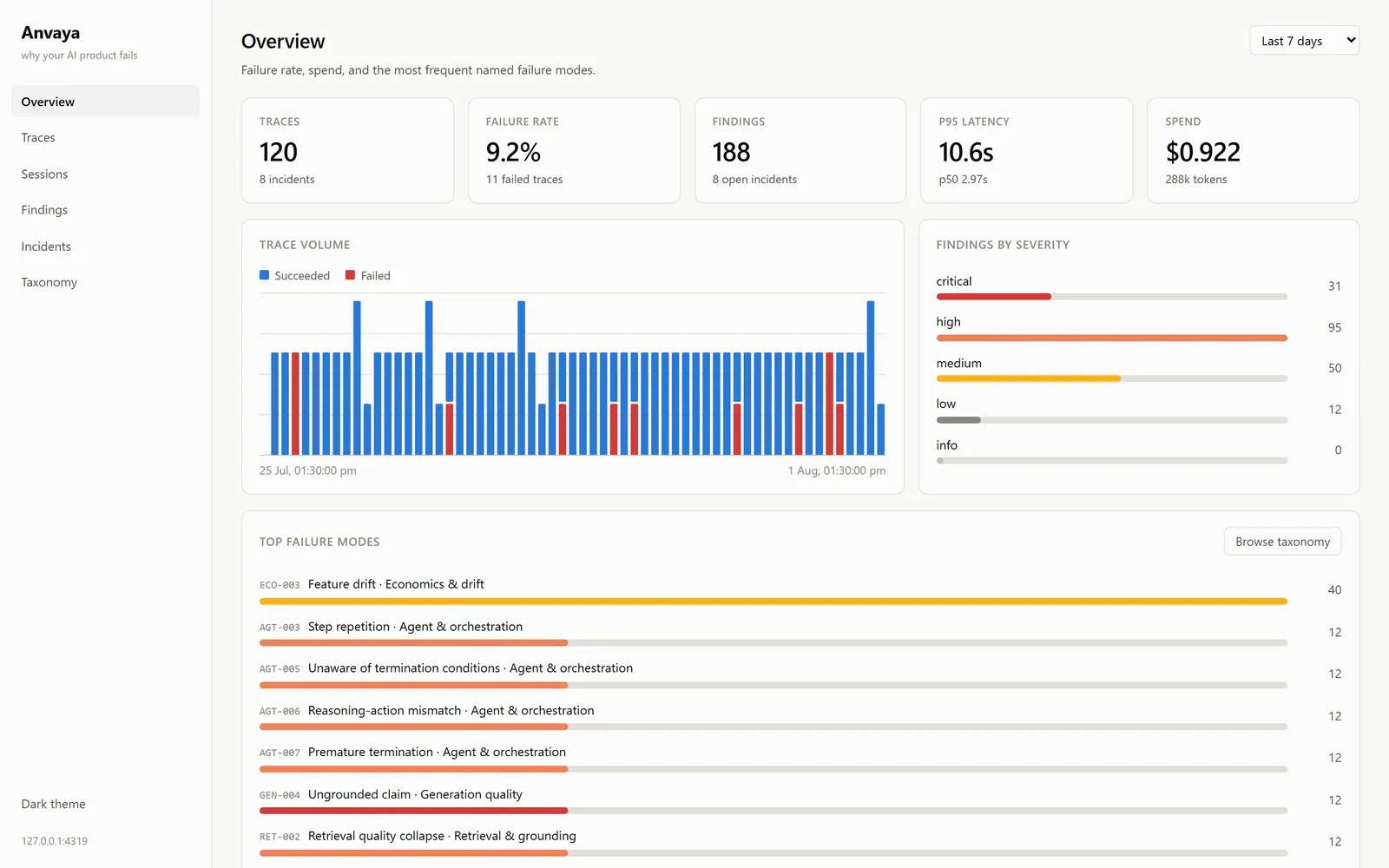
Anvaya adds the third thing: diagnosis. It ingests execution traces, detects failures against a named taxonomy, and attributes each one causally across the span tree. The output is not a confidence score. It is an incident that names the failure mode, points at the originating span, lists the downstream symptoms, and suggests remediation.
The taxonomy is the foundation. 56 named failure modes across 8 families, built from published research rather than invented: it covers all 14 modes from the MAST multi-agent study, all 7 failure points from the Barnett RAG paper, and 6 entries from the OWASP LLM Top 10. Each mode carries a definition, a source, and a remediation note.
Detection runs cheapest-first across four tiers, and that ordering is driven by the data rather than by frugality. The most frequent failure modes in the research are also the cheapest to catch. Step repetition, the single most common multi-agent failure, is a cycle in the span tree. Paying a language model to detect a graph cycle is indefensible.